Editing Files at 1000 Tokens per Second
A new model and inference method for high-accuracy full-file edits at 1000 tokens/s.
📝 摘要
这篇文章来自 Cursor 博客,介绍了他们训练的专门用于代码编辑的 "fast-apply" 模型,实现了约 1000 tokens/s(~3500 char/s)的全文件重写速度。文章核心观点:代码编辑可分为规划和应用两个阶段,应用阶段应快速且即时。他们发现让模型重写整个文件比输出 diff 更准确——diff 格式对模型来说是 out of distribution,且行号计算是模型已知的弱项。通过在 Llama-3-70b 上微调,并结合自研的 speculative edits(针对代码编辑的推测解码变体),实现了约 13x 的加速。未来方向包括长上下文训练、知识蒸馏和基于策略的 RL 训练。
核心概念: 代码编辑应将规划与应用解耦,应用阶段通过专用模型 + 推测解码实现极致低延迟的全文件重写,而非依赖 diff 格式。
关键技术栈 / 关键要点:
- 全文件重写优于 Diff — 模型在预训练和后训练中见过更多完整代码而非 diff,diff 需要精确行号(模型 notoriously 不擅长),且 diff 使模型在更少 token 内完成思考
- Speculative Edits — Cursor 发明的推测解码变体,利用代码编辑中强烈的确定性先验(而非 draft model)推测未来 token,在 Llama-3-70b 上实现 9-13x 加速
- 合成数据训练管线 — 从 cmd-k 提示数据出发,用 GPT-4 生成对话响应,再用 LM "应用" 变更,80/20 混合真实和合成数据微调
- Claude-3-Opus-diff 表现最优 — 在 diff 格式中 Opus 超越 gpt-4-turbo-spec,但推理速度不够,需自训练模型+推测解码
- 与 Fireworks 合作部署 — Fireworks 推理引擎支持自定义推测逻辑,使 speculative edits 的加速增益在 Llama-3 上大于 GPT-4
- 长上下文与知识蒸馏 — 未来方向:支持 2500 行文件的长上下文训练(朴素 RoPE 缩放效果差)、将能力蒸馏到 Llama-3-8b 小模型以降低大文件延迟
关键结论 / 实践建议: 对于编码智能体,低延迟的 "apply" 能力是关键构建块——模型越擅长推理/规划,对快速应用的需求越大。fast-apply 是更复杂代码生成系统的基石。
Frontier models such as GPT-4o struggle on large edits, with problems of laziness, inaccuracy, and high-latency.
This is a weakness visible in coding agents. Accurately editing hundreds of lines can take multiple model calls, at times trapping the agent in an infinite loop. Even small, isolated edits are plagued with bugs.
Worst of all, existing models are slow at large edits, breaking the programmer out of flow.
We've trained a specialized model on an important version of the full-file code edit task called fast apply.
Difficult code edits can be broken down into two stages: planning, and applying.
In Cursor, the planning phase takes the form of a chat interface with a powerful frontier model. Applying the change to the current file should be straightforward and instant.
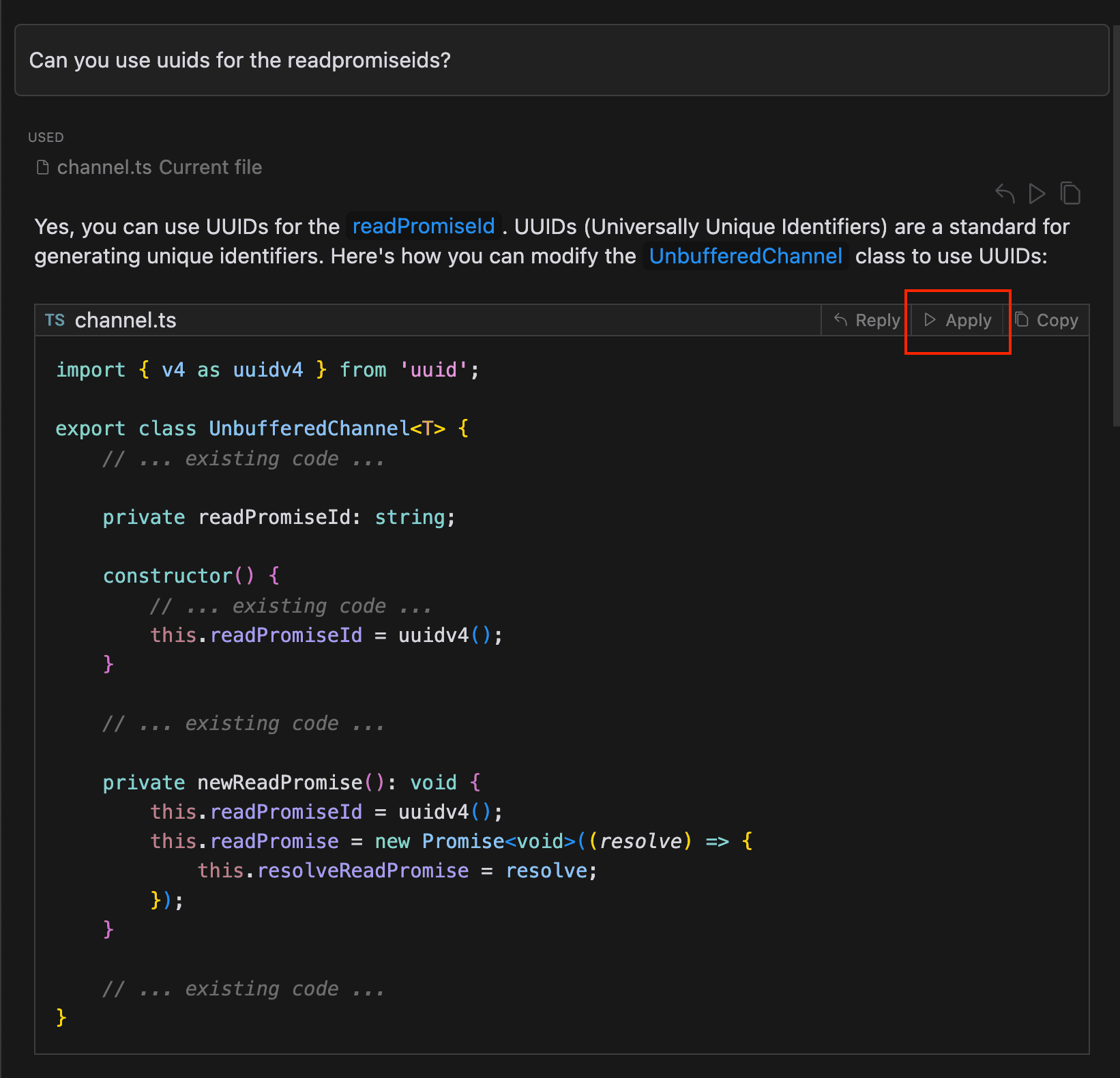
A toy example of a change we want to 'apply'. It cannot easily be copy/pasted since it sketches out the change over a full class
Our fast-apply model surpasses GPT-4 and GPT-4o performance and pushes the pareto frontier on the accuracy / latency curve. We achieve speeds of ~1000 tokens ** (around 3500 char/s) on our 70b model using a speculative-decoding variant tailored for code-edits, called speculative edits.
This means a ~13x speedup over vanilla inference using Llama-3-70b and a ~9x speedup over our previous GPT-4 speculative edits deployment.
By default, we have language models generate the fully rewritten file conditioned on the current file, the conversation history, and the current code block.
In this post, we explain how we trained and evaluated our new model. We show why we rewrite the file instead of using diffs and how speculative edits give us such ridiculous speedups.
Evaluating Prompted Rewrites
We construct an evaluation set of ~450 full-file edits of files under 400 lines, then measure the performance of several prompted models using Claude-3 Opus as a grader.
Across tens of curated examples, Opus-based grading shows more agreement with our ratings than GPT-4-Turbo or GPT-4o.
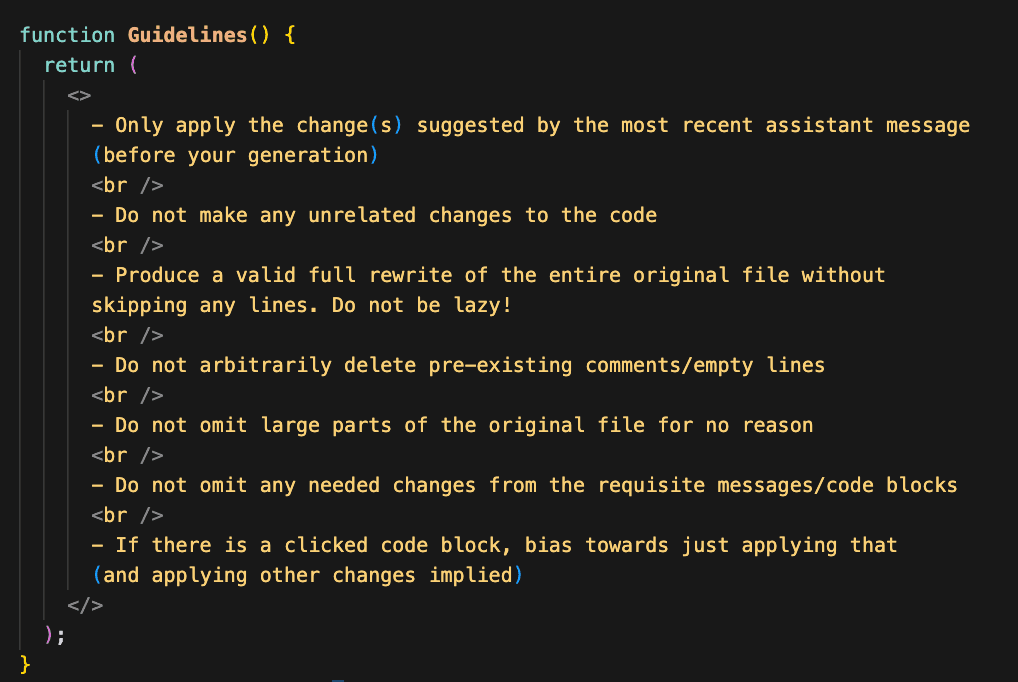
The Priompt component for grading guidelines
These scores likely bias towards outputs of Claude models. But the scores also match our qualitative assessments of the models.
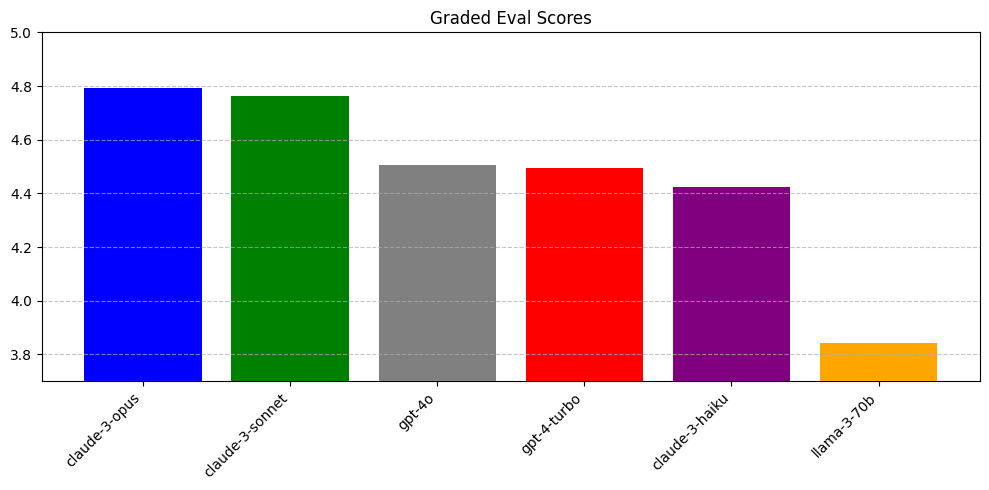
Surprisingly, claude-3-sonnet outperforms gpt-4-turbo. And gpt-4o performs similarly to gpt-4-turbo.
We hypothesize Claude's superior performance is an artifact of post-training. The claude models output thousands of LOC in assistant messages, while GPT-4 omits code and indicates missing regions with ... or comments.
GPT-4's poor performance can also be attributed to unrelated changes. GPT-4 deletes commented out code and unnecessary newlines. It has a tendency to "fix/clean up" unrelated code.
Speed Measurements
We measure speed as:
This has the advantages of:
- Normalizes speed across different tokenizers
- Presents a single number we care about across various prompt/generated token lengths (vs counting both TTFT and generation char/s)
- Gives a strong lower-bound on generation-speed since the latency includes TTFT. For most tokenizers and text, a token is 3-4 characters, so dividing char/s by 4 gives a tokens/s lower bound.
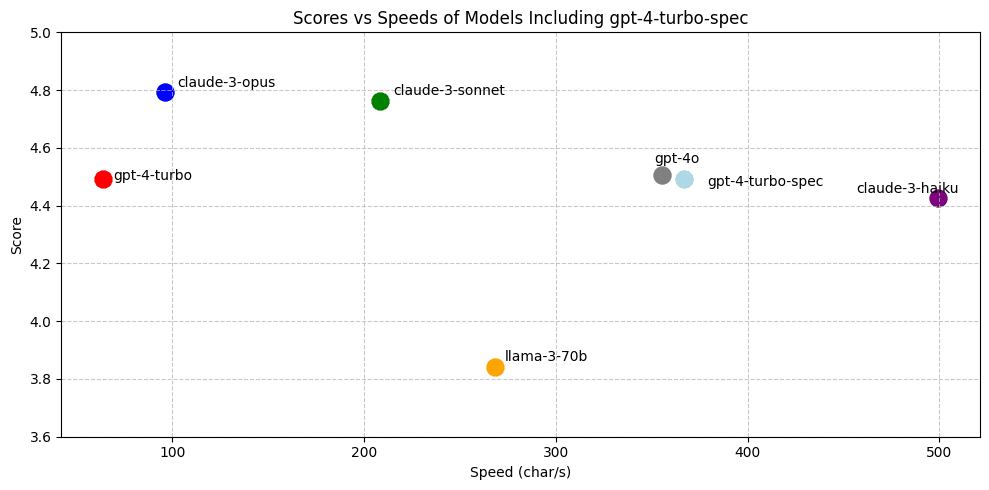
Top and to the right is better. opus, sonnet, gpt-4o, and haiku are on the pareto frontier.
When we include speedups from gpt-4-turbo speculative edits:
With speculative edits, gpt-4-turbo performs similarly to gpt-4o. Speculative edits are not yet possible with gpt-4o, otherwise gpt-4o-spec would be the speed frontrunner.
Diff Models
Why do we have the model rewrite the entire file, instead of suggesting diffs?
We found that language models struggle with diff-formatted edits for a few possible reasons:
Thinking in Fewer Tokens - With more output tokens, the model has more forward passes to determine the correct solution. Diffs force the model to think in fewer tokens.
Diffs are Out of Distribution - In pretraining and especially post-training, models have likely seen more full-files of code than diffs of code.
Outputting Line Numbers - If a tokenizer treats a sequence of numbers (i.e. 123) as a single token, it must make up its mind about the correct line number for the diff on a single (often the first) output token. Furthermore, models are notoriously bad at counting line numbers.
Motivated by the diff format from Aider, we eliminate the line number problem. Instead of a standard diff format, the model proposes diff hunks as search/replace blocks:
diff
@@ ... @@
function binarySearch(arr, x) {
- let low = 0, high = arr.length - 1;
- while (low <= high) {
- let mid = Math.floor((low + high) / 2);
- if (arr[mid] === x) {
- return mid;
- }
- low += 1;
- }
- return -1;
+ let low = 0, high = arr.length - 1;
+ while (low <= high) {
+ let mid = Math.floor((low + high) / 2);
+ if (arr[mid] === x) {
+ return mid;
+ } else if (arr[mid] < x) {
+ low = mid + 1;
+ } else {
+ high = mid - 1;
+ }
+ }
+ return -1;
}
We replace all lines starting with - or with lines starting with + or . The diffs have redundant - s and + s so the diff-parsing system is robust to minor model failures.
Most models fail to output accurate diffs, with the exception of Claude Opus.
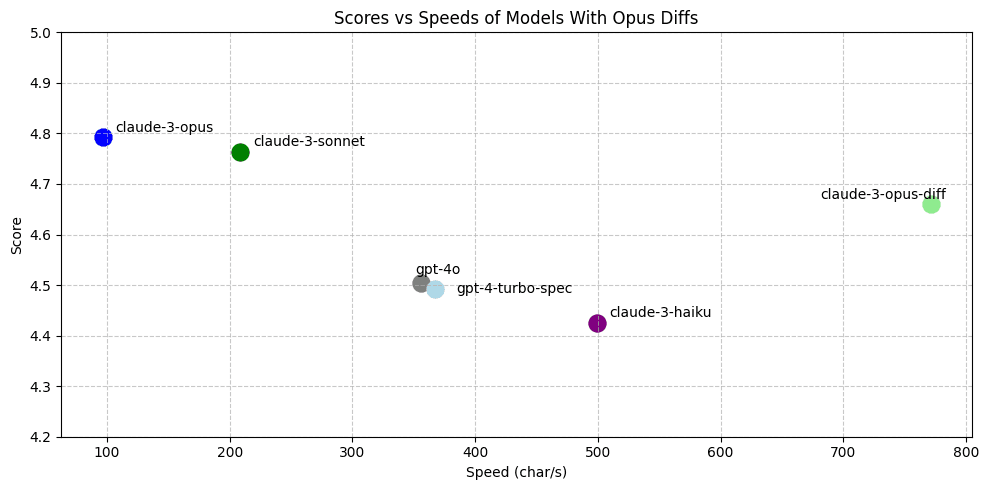
claude-3-opus-diff is Claude Opus prompted with a modified version of Aider's diff format. It beats gpt-4-turbo-spec on speed and accuracy. gpt-4o-diff is omitted from the graph as it achieves a median speed of 2476 char/s, but performs far worse than claude-3-haiku (4.18 avg eval score).
Training
The claude-3-opus-diff apply model is faster and more accurate than gpt-4-turbo-spec, but is still too slow.
It is not possible to build speculative edits into any of anthropic's models, so we need to train and deploy a performant custom model.
Synthetic Data
We begin with a small number of "fast-apply" prompts and an abundance of cmd-k prompts.
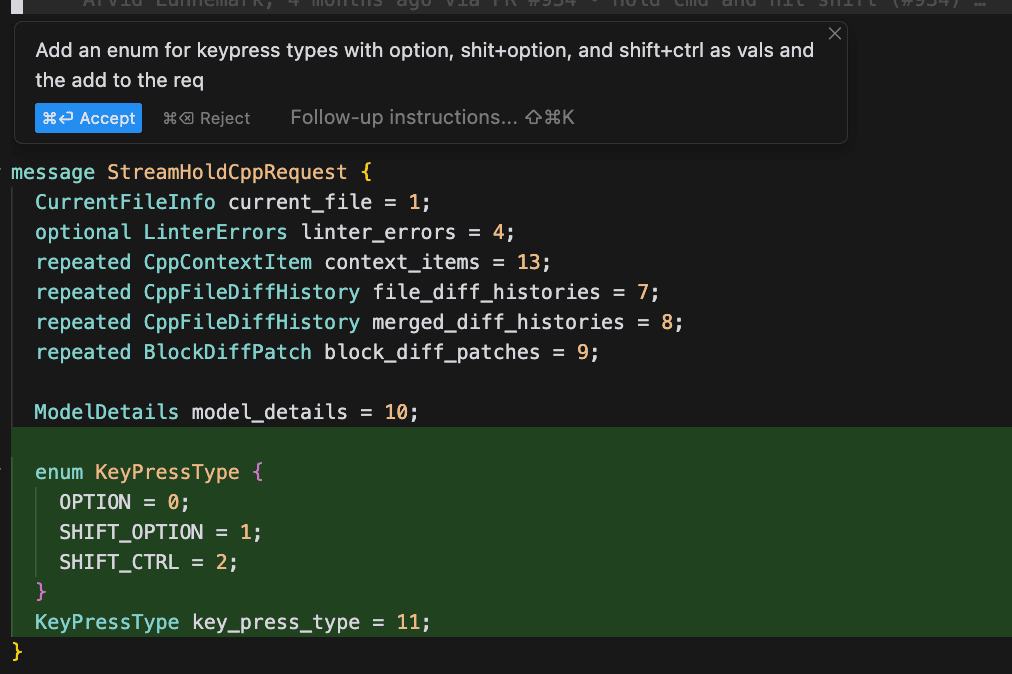
An example [cmd-k](/agent#cmd-k) prompt and the corresponding generation. Cmd-k lets you instruct the model to make an edit in a selected region.
A cmd-k prompt loosely resembles the data we need for fast-apply. It contains an edit instruction, and a code selection in the current file.
For each edit instruction, we have GPT-4 produce a chat response given the current file, then have a language model "apply" the change. We use the small dataset of "real" apply inputs to produce additional higher-quality apply datapoints. Finally, we concatenate these datasets together in an 80/20 mix to get our finetuning data.
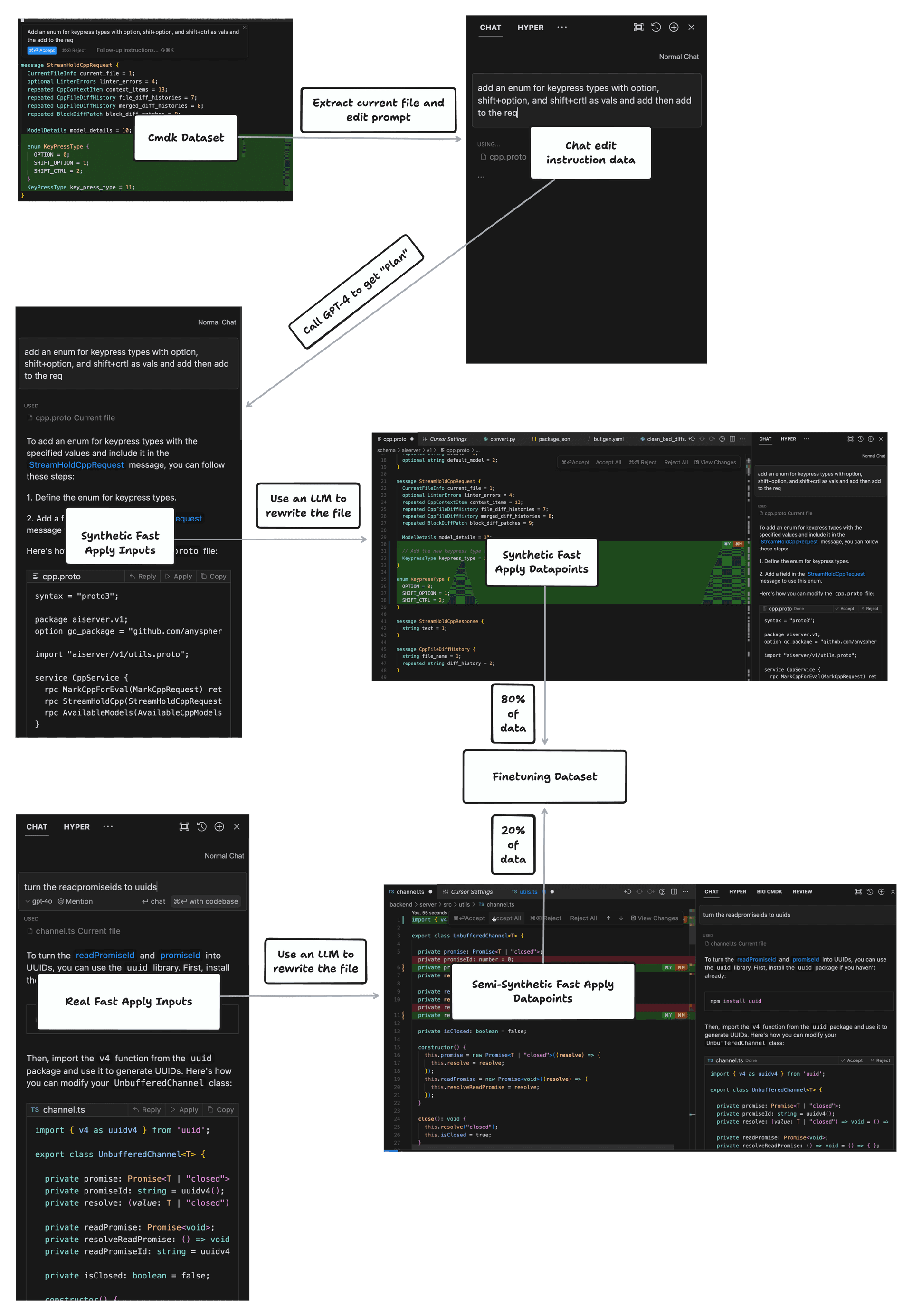
Our data pipeline for generating the fast-apply finetuning dataset. The fully synthetic data is lower quality. For instance, in the example above, the selection range (which we throw away) is crucial for an accurate edit.
Model Training
We train the Deepseek Coder Instruct and Llama 3 model families. To improve our finetuning dataset, we:
- We downsample small files since they were over-represented in our train set (<100 LOC).
- We downsample the number of training examples per filename.
- We downsample datapoints that resulted in no-ops.
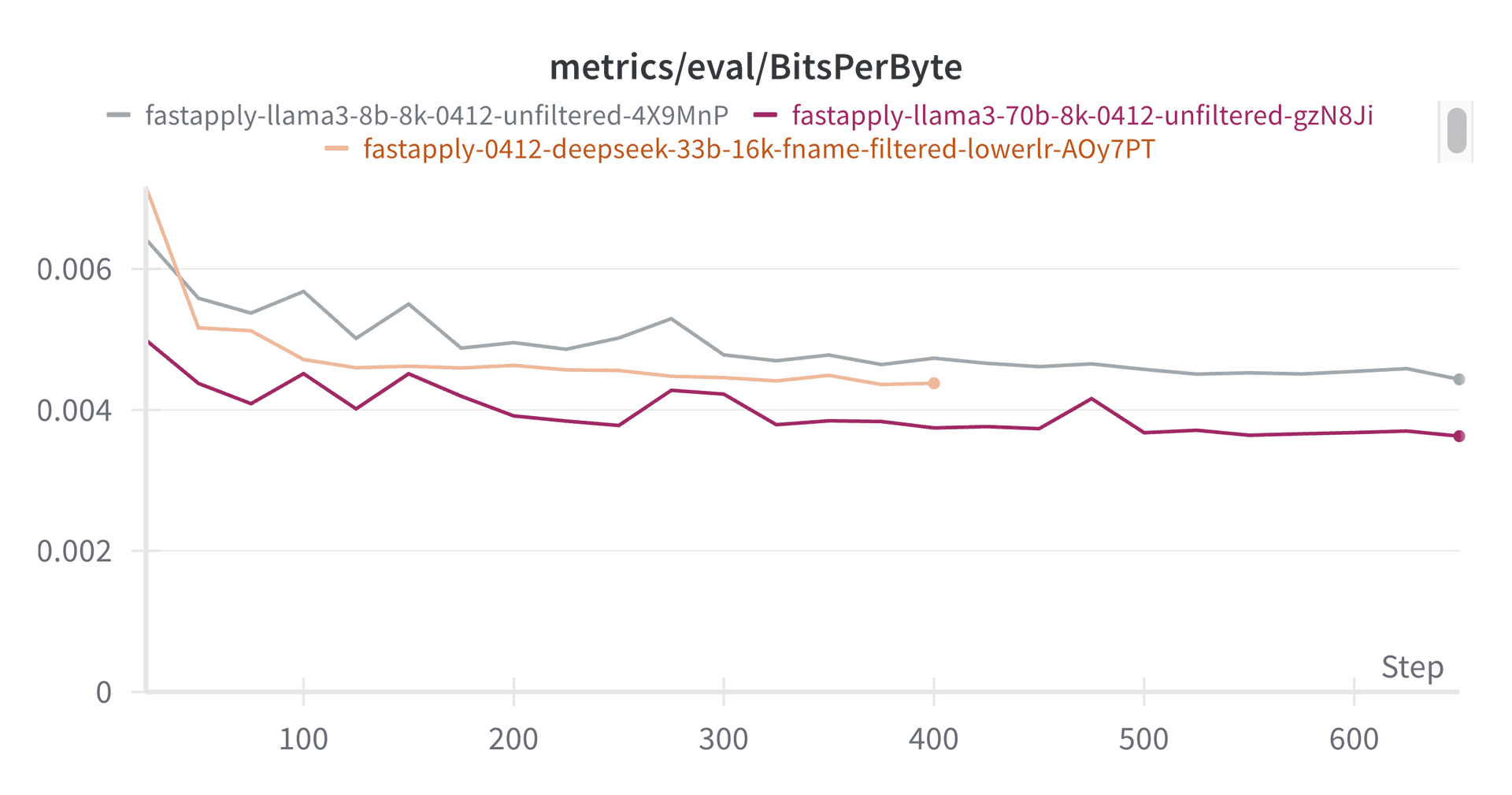
We find that our best model (llama-3-70b-ft) almost matches claude-3-opus-diff and outperforms gpt-4-turbo and gpt-4o.
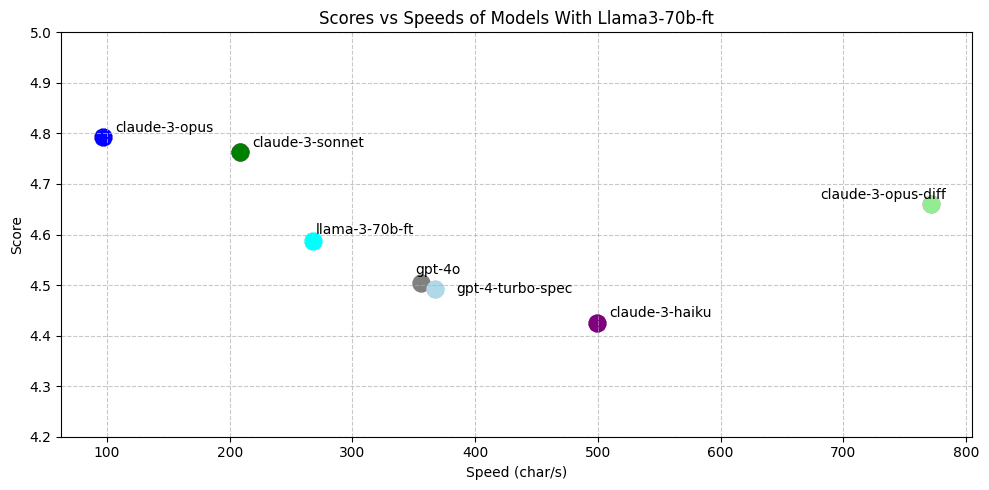
Llama-3-70b-ft outperforms gpt-4-turbo-spec in performance.
All three finetuned models outperform gpt-4-turbo on evals, but we could feel the difference between the finetuned deepseek-33b and llama-3-70b. Llama-3-70b felt better than other finetuned models and gpt-4-turbo. The other finetuned models felt not-quite-useful enough, often less useful than GPT-4.
Speculative edits
Our biggest win comes from our custom speculative decoding algorithm called "speculative edits". It is equivalent to a full-file-rewrite, while being up to 9x faster.
With code edits, we have a strong prior on the draft tokens at any point in time, so we can speculate on future tokens using a deterministic algorithm rather than a draft model.
We've worked with Fireworks to deploy our fast-apply model with strong speculative edits support. They have a fantastic inference engine and built out api support for our custom speculation logic.
This makes the gain from speculative edits larger for Llama-3 than GPT-4, meaning a 4-5x speedup over the next fastest model.
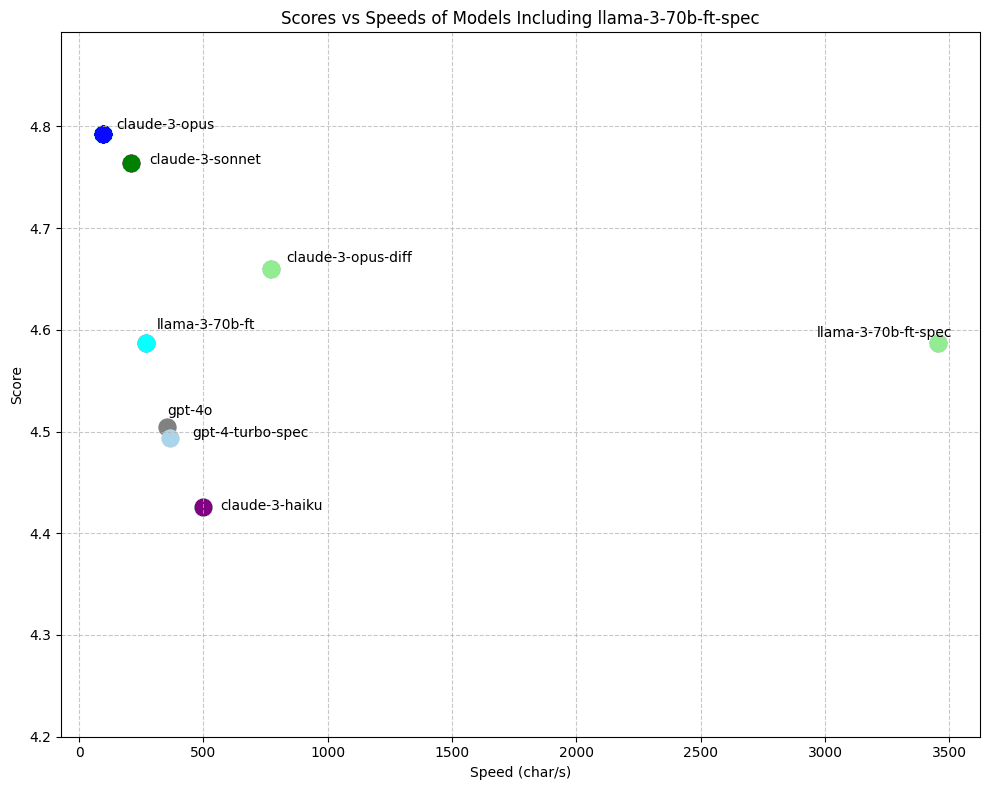
Speculative edits give our finetuned model a **massive** speedup.
Future Directions
Long Context Training - We are working on long-context training to rewrite files up to 2500 lines long. Naive linear scaling of RoPE position ids works poorly -- as do current community long-context finetunes of Llama 3 70b.
Knowledge Distillation - We'also like to distill the "fast apply" abilities of the current model into a smaller one, particularly llama-3-8b. The lower latencies from smaller models will matter more for larger files.
Even Better Accuracy - Some form of on-policy RL using data from the newly rolled-out model should give us additional performance wins.
Past its usefulness in chat, fast-apply is crucial building block for more sophisticated code-generation systems. As models get more capable at reasoning/planning, there are increasing benefits to a low-latency apply!
If you haven't already, you should try out this feature in Cursor! It's a small example of the polish and depth that goes into the product.
This blog post is a reasonable sample of the applied research we do at Cursor. We build application-specific inference speedups like speculative edits, train and evaluate task-specific models, and ship these in useful features to users.
We're hiring research engineers and software engineers! You can learn more at cursor.com/careers.
相关文章产品
[
介绍 Projects
Alexi & Fredrika2 分钟阅读
](https://cursor.com/cn/blog/projects)客户
[
Basis 如何借助 Cursor 构建长周期会计智能体
Cursor Team1 分钟阅读
](https://cursor.com/cn/blog/basis)客户
[
Nokia 借助 Cursor 在两周内分析超过 5000 万行代码
Cursor Team2 分钟阅读