Black–Scholes: the heat equation → options pricing.
Convolutional nets: the visual cortex → computer vision.
The same solution pattern transfers from completely different domains and enriches the new fields. You can now have knowledge that lived in one field, reach another, and make something new become possible.
Sandboxes were the agent story of the year, and they matter more every month as agents get more independent. Each agent gets its own isolated computer to run code and experiment without breaking something that matters.
The problem shows up the moment you run more than one. Every sandbox starts cold. Cold start is when an agent works out how your system behaves every time it starts.. The next agent re-derives the same thing. So does the one after that. You pay for the same discovery again and again**. It's a tax on every multi-sandbox workflow.** We saw this firsthand at our last hackathon with @daytonaio, led by @ivanburazin , one of the sharpest teams in the sandbox space.
And “reuse knowledge” here isn't the whole story. Usually these agents run at the same time, so you want the learnings shared live, the moment one of them finds something.
Concrete example: You point a research agent at problem X and attack from three directions at once: three agents, three sandboxes, in parallel. A, B, and C.
Agent A grinds through a hard sub-problem. Many tokens, a couple of hours, and it cracks it. Later B hits the same wall, but its prompt was framed slightly differently and it stalls where A didn't. Without shared memory, B burns more time and compute, and what A learned never leaves A's sandbox. With shared memory, A's result is written the moment it lands. B checks memory, skips the wall, keeps moving. No agent re-pays for a discovery another already made.
Sandboxes + agents in different domains (The real unlock!) #
Now that we went through the efficiency case, let’s elaborate on the most interesting one: sharing knowledge across different domains.
Black–Scholes: the heat equation → options pricing.
Convolutional nets: the visual cortex → computer vision.
Velcro: burdock burrs → fasteners.
Sonar: bat echolocation → submarine detection.
None of these pairs share similar terminologies. A burr is not a fastener, the heat equation is not an option. What they share is a shape. Someone recognized that a problem in one field had the same structure as a solved problem in another, and carried the solution across. If you could reliably abstract problems and solutions into patterns and map them between domains, you'd solve a huge share of the problems that look hard only because no one has connected them yet.
The catch has always been that this mapping lived in one head. The transfer only happened if the burrs and the fasteners were known by the same person. That's the bottleneck.
So flip it. You don't need one person who knows both fields. You need specialists who don't, and a shared place where their knowledge can meet.
Put one agent deep in biology and another in materials science. Each stays in its own sandbox, an expert in its own space, unaware the other exists. The only thing they share is memory.
Transfer of knowledge happens at the level of structure, not words, so the learning has to be stored as structure. The entities, how they relate, the shape of the solution. Stored that way**, a problem in one domain can match a solved pattern in another even when nothing on the surface looks alike.**
Sandboxes make agents experts. Shared memory lets experts hand knowledge to each other across fields that have never spoken. Put them together and you don't get a faster lab. You get the conditions for the next big discovery.
Concrete example:
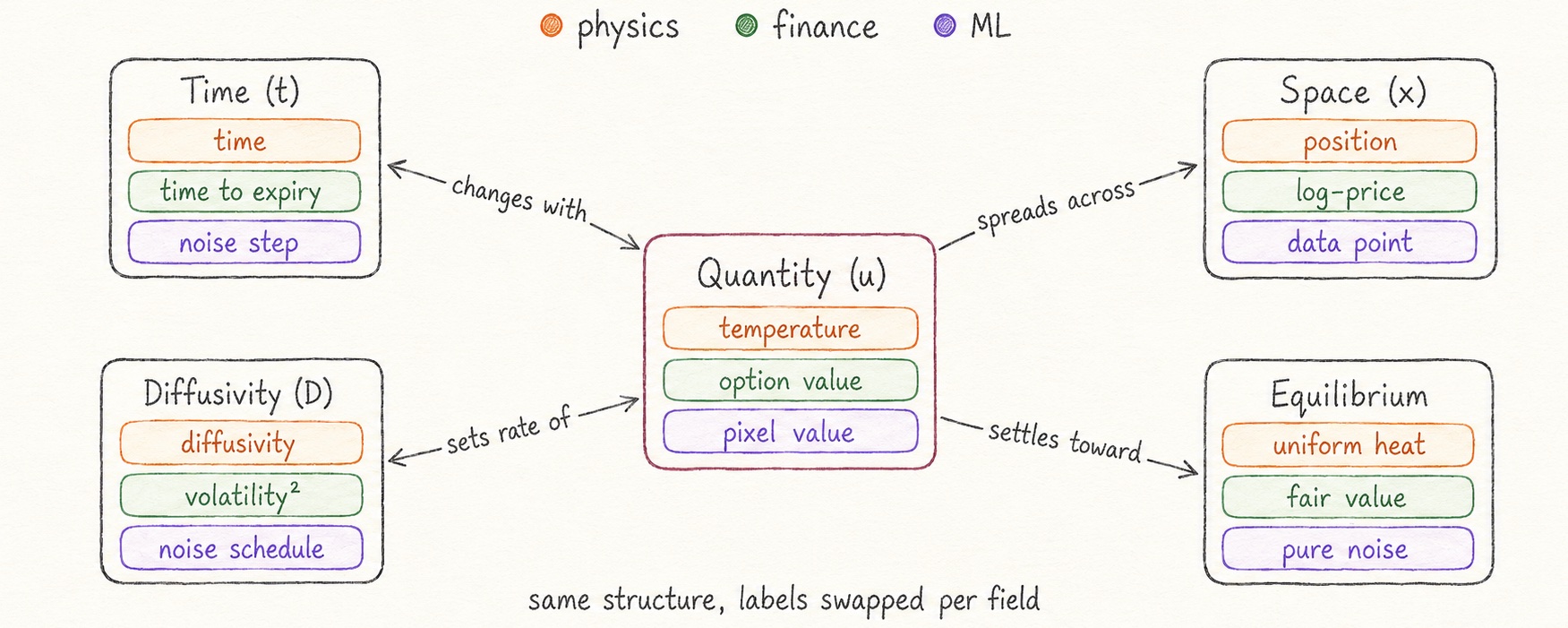
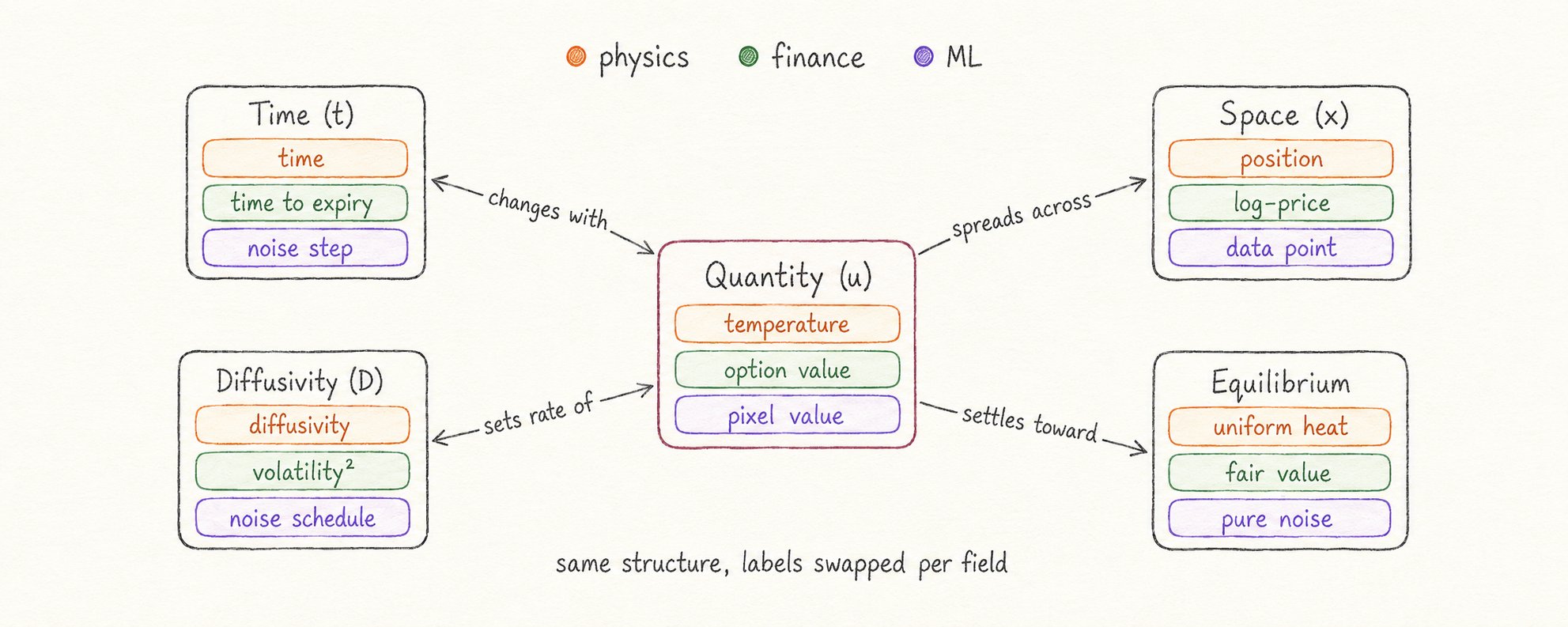
Take one pattern: diffusion. A quantity spreads through space and smooths out over time. A physics agent meets it as heat moving through a metal rod and solves it. What it writes to shared memory isn't "heat." It's the structure: a quantity that changes with time, spreads across space, scaled by a rate, settling toward equilibrium. Entities and edges. A graph.
A finance agent, in its own sandbox, is pricing an option. The surface looks nothing alike: strike prices, volatility, expiry. But the graph underneath is identical: with a change of variables, Black–Scholes is the heat equation, the same nodes relabeled. The agent queries memory, matches the structure, maps it across. An ML agent denoising an image lands on the same graph a third time.
Agents no longer share just raw context; they start sharing a context structure. They share meaning instead of just information. What used to be weights in the model now moves to weights in the memory.