Moats in the age of floods
As the labs break revenue records and absorb more capabilities, there's a growing narrative that the great flood of intelligence they bring ...
📝 摘要
本文反驳了"AI 实验室的能力洪水将淹没应用层、不再有护城河"的叙事,提出智能是一种需求无上限的公用事业,企业应建设"水坝和水道"——即扩散智能的基础设施——而非依赖防御性护城河。作者指出,AI 能力与制度化采纳之间的时间差是当前世界上最大的套利窗口,但该窗口仅开放短暂时间。
核心概念: 智能是需求无上限的公用事业,价值将集中于能把原始 token 扩散为真实世界结果的公司,而非单纯拥有最强模型的实验室。
关键技术栈 / 关键要点:
- 人类现实的惯性 — GPT-5.5+ / Opus 4.5+ 级别模型若在 2019 年出现,人们会认为 AGI 已至,但经济并未如预期转型;现实世界的复杂性、上下文状态、人际协调和制度惯性是真正的瓶颈
- (1) 编排多人网络 — 瞄准人类协调成本最高的市场,构建人+Agent 协作端到端工作流,积累协调图谱形成难以撼动的位置(如 Harvey)
- (2) 积累工作流引力 — 成为客户数据的可信汇聚源,捕获领域专属数据和过程数据(纠错、决策、异常),构建持续学习层实现个性化与组织记忆
- (3) 让客户拥有变革 — 智能将成为被分配和管理的资源(token 预算如人头),提供 Agent Builder、可配置工作流、模型中立性/选择权、成本可见性等控制功能
- (4) 讲述你对未来的版本 — 在高度不确定的世界中,提供具体可信的行业五年愿景比功能列表更有价值,品牌认同感不可被轻易替代
- (5) 持续攀登抽象层 — 从服务个人用户演进到服务经理→VP→C-suite,持续垂直化 UX,在当前层被模型能力商品化之前主动拆毁并重建
- (6) 卖以前不可能的东西 — 从按座计费转向按结果计费(tickets closed、contracts processed、drugs into trial),捕捉"智能过于便宜以至于无需计量"的二阶效应
- (7) 成为结构性必需品 — 做实验室做不到的事,成为制度、监管和人际网络真正需要的中立层、信任层或可被追责的对端
关键结论 / 实践建议: 平台会变得巨大但价值仍会在其上方积累(云平台未阻止 Stripe/Shopify/Salesforce 等成为时代级公司);核心竞争是垂直领域逐个争夺的战争,由不像实验室的公司来打。

As the labs break revenue records and absorb more capabilities, there's a growing narrative that the great flood of intelligence they bring will drown the whole economy. That the app layer is dead and that there’s no moats to build as we march towards AGI.
I see it differently.
Moats are useless to defend against a flood. But dams & waterways that direct the water & power to crops, reservoirs, and homes that otherwise wouldn’t have it are critical infrastructure.
Intelligence is a utility with unbounded demand. And similar to critical utilities like water and electricity, we need to build the systems to maximally disperse it.
The world doesn’t just want raw models and agents; it wants problems resolved and outcomes achieved. The premium will sit with the companies that can diffuse this intelligence through every aspect of civilization, converting raw tokens into real world outcomes, transforming industries, and creating economies in the process. That work has barely started.
The inertia of human realities
Imagine if any of us saw GPT 5.5+ / Opus 4.5+ back in 2019. Not only would we say that it's AGI, but we would’ve expected the economy to be completely transformed by now. That simply hasn’t happened.
Why? Because reality is very complex, and jagged intelligence isn't the bottleneck for most work at human levels.
Some of it is a context problem. Real work carries more state, more exceptions, and more history than fits in any prompt. It’s really hard to know how a job actually works because it’s really hard for the people doing it to describe it out loud.
A lot of it is that the real world is stubbornly very human. Simply put, a country of geniuses alone in a data center couldn't run the country. The real world is tangled up in incentives, approvals, accountability, edge cases, legacy systems, and humans coordinating with other humans. Even as automation improves dramatically, people enjoy hearing from, seeing, and working with other humans. No one watches Deep Blue play chess.
Through history, adoption and true economic change have always been de-coupled in time. Electricity was wired into factories by the 1880s, but didn't show up in productivity statistics until the 1920s once the factories were transformed around it.
With the internet and AI, adoption speed keeps compressing by an order of magnitude, but institutional change continues to lag.
This gap is the largest arbitrage in the world right now, BUT it’s only open for a short window.
The roadmap for diffusing intelligence
Taking advantage of the gap involves making the right bets and then executing relentlessly on the tactics to ride the capability curve of the models. You have to transform your domain through product, services, and narrative all together, and with the customer at the center of all three.
Whether you’re an AI-native new entrant or an AI-pilled incumbent, the road is far from clear, but here are the things you can do to maximize your chances:
- Orchestrate a multiplayer network
- Accumulate workflow gravity
- Let customers own their transformation
- Tell your version of the future
- Keep climbing the abstraction
- Sell what wasn’t possible
- Make yourself a structural necessity
Note: it’s likely not enough to only do one of these given how competitive the world is. You must do most of these over time.
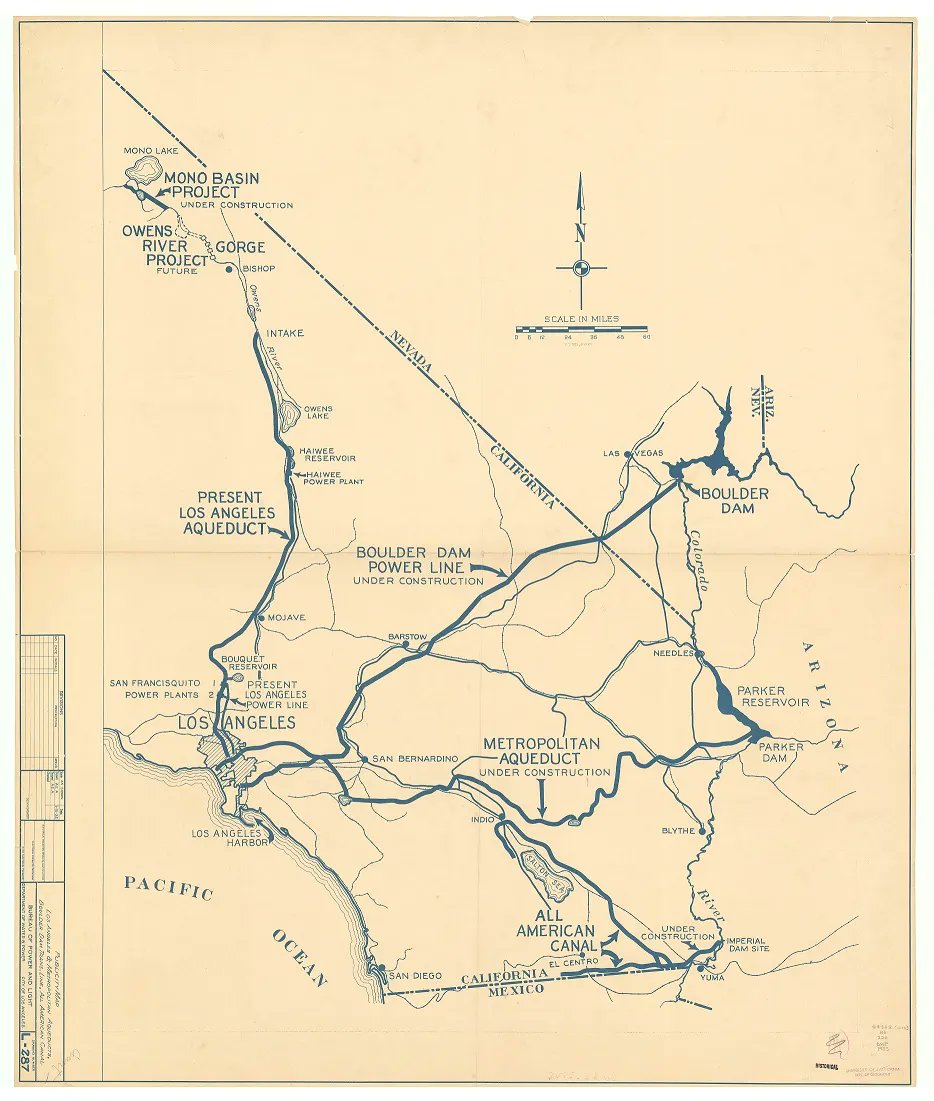
This 1935 plan maps the water and power infrastructure that enabled the region from Las Vegas to Los Angeles to flourish
(1) Orchestrate a multiplayer network
The labs will be primarily incentivized to tokenmaxx individual productivity because it’s the easiest to diffuse maximally using a limited set of products. While that's useful, it caps the productivity improvements because a firm is worth more than the sum of its people. It’s why a smaller, better-run company can beat a larger one. The advantage isn't always the headcount but the coordination, allocation, and review built into how the org is structured.
Target markets where human coordination cost is highest. Then build products and services that allow those humans and agents to collaborate to get these workflows done end-to-end. Over time, you’ll accumulate a coordination graph of individuals, agents, data, and organizations that are all transacting and collaborating through your product; a position that’s very hard to unseat by any one AI itself.
Ex: Harvey’s (@harvey) product & vision for collaboration between F500 clients and their law firms orchestrates arguably the highest value relationships in the world.
(2) Accumulate workflow gravity
Be the trusted source for accumulating your customers' data. There are internal documents, communications, institutional knowledge, proprietary sources, all the stuff general-purpose models will never see in pre-training. And then there's the process data: every correction, every decision, every past scar, and every exception your product and the ecosystem around it generates as people use it.
Can’t the labs just do this? Yes, of course. But the key is going to be using your understanding of the domain and the unique data you’re capturing to improve value to the customer. With the model ecosystem fragmenting and enterprises’ perennial need to hedge risk against single providers, it’s likely that a continual learning layer is going to be divorced from the models. This presents a wedge to build memory and personalization in ways that benefit both the user and the whole organization.
Over time you’ll know more about how a specific slice of the economy operates than anyone else, including the people running it. Like gravity, the more knowledge you accumulate, the harder it is for anything to escape your orbit.
Ex: Within (@tryklarity) captures the latent work each person in the enterprise does to proactively suggest automation opportunities both to the individual and org.
(3) Let customers own their transformation
This one is non-obvious and only just starting to be in vogue. I’ll posit that intelligence becomes an allocated and managed resource next year: tokens budgeted like headcount and ROI measured against top level metrics. Just like any other managed resource, customers will want fine grained control over it. The challenge is calibrating that control. Give them too little and they never own it. Give them too much and they're vibe-coding their own version internally instead of getting the full value of yours.
Agent builders, configurable workflows, model neutrality/choice (incl post-trained open models), cost visibility, permissions, and many more features will give organizations control over their own change. To implement, you’ll need to forward deploy with their teams, but make sure they can still manage deployments themselves when you leave. At the end of the day, ICs to C-level value what they helped build even more than if it was handed on a silver platter (see Ikea Effect).
Ex: Applied Compute (@appliedcompute) provides a platform for enterprises to create their own intelligence, effectively controlling their own destiny.
(4) Tell your version of the future
As we head towards superintelligence, rapid model releases, multiple global conflicts, new fundraises, and M&As, add tremendous uncertainty to an already uncertain world. Everyone from ordinary people to the C-suite of the largest companies in the world is confused about what the future looks like. The most important thing you can do is offer a specific and credible account of what their industry will look like in five years. Being known as the company that can help guide into the future is critical. This is worth way more to them than a list of features.
And then pair that with an identity that proposes your role in that future. Stand for something. Have an opinion. Think differently and weave it into a visual & cultural brand that permeates through new hires, customers, partners, investors, and the general public. When every company has access to the same models, the unique choices you made in your product, relationships, website, and story create a brand affinity that can’t be easily exchanged.
Ex: Parallel’s (@p0) vision for the web’s second user, retro brand, and reliable product suite have helped them standout with buyers & talent.
(5) Keep climbing the abstraction
In code, we’ve transitioned from writing assembly, to compiled languages, to agents, and soon to orchestrating teams and orgs of agents. The same will happen in non-coding domains but will be slower depending on how verifiable they are. The bottom of the capability stack gets eaten by model improvements, and whatever you built for the current bottom gets eaten with it.
Over time, evolve your product to cater to the line manager, then the VP, then eventually the C-suite, instead of only the user you started with. In practice this means getting more verticalized in the UX, not less. For example, building the command center where a manager oversees a fleet of agents the way they'd run a human team in their function today.
The companies that survive will be the ones that predict where the abstraction is heading and start building there before the current layer gets commoditized underneath them. Be ruthless about tearing up your own infra and product to climb the next layer - no sacred cows here.
Ex: Factory (@FactoryAI) saw this early, betting on the move from individual coding droids to a software factory, years before the market or capability got there.
(6) Sell what wasn’t possible before
So far, most ways to value and understand the P&L impact of AI have been tied to the human work of a lawyer, engineer, analyst, scientist, etc. This is why many AI native companies are still pricing on seats. But the real unlock is what’s bottlenecked on human labor, attention, or brains. These are when you see the 2nd and 3rd order effects of intelligence too cheap to meter, and where the unbounded ROI lives.
In 2027, I predict that the defining C-suite conversation will be AI’s impact on the P&L of every business, as companies are forced to justify a new line item for token and AI spend. That spend will need to either drive revenue or reduce opex, and the companies that win will be the ones already reshaping their products and customer relationships to capture the value.
As capabilities increase, price against something the customer already forecast or goal on like tickets closed, contracts processed, drugs into trial, claims resolved, cases cleared, and the holy grail, new revenue. This will take a while to fully materialize as AI and product capabilities catch up. But the companies that start now will be the ones that own the economics when it does.
Ex: Armadin (@ArmadinSecurity)’s new hyperattack finds vulnerabilities with thousand agent swarms, pen testing at a scale and frequency that no service firm could replicate.
(7) Make yourself a structural necessity
This is the hardest to do and is really the accumulation of all of the above. Every company ever has been under-resourced because there’s always more to do. AI doesn’t change that. Ultimately the labs will have to focus on general-purpose products that offer the largest TAMs: model APIs, enterprise coworkers, and eventually mega-markets like pharma.
Your job is to position yourself to do things labs can’t do and make something that institutions, regulators, and networks of people genuinely need to exist. This could include offering neutrality between competing options, a trusted layer between AI and regulated industries, or a counterparty that can be held accountable in ways a model API can't. Capitalism pushes these companies into existence because the system can't function without them. Make yourself one of those.
Ex: Profound (@tryprofound) is betting that even in a world of many competing consumer AGIs, every company in the world will need a neutral layer measuring and shaping awareness w/ their customers.
The biggest companies in the world
Don’t get me wrong. The models are going to get genuinely and breathtakingly capable. The labs and chip companies will make an extraordinary amount of money and will likely be the biggest companies in the world. Ultimately someone has to collect money for the pareto optimal token cost to return all the capex investment.
But this is not the debate. Platforms get enormous and value still accrues above them. Cloud didn't stop Stripe, Uber, Doordash, Salesforce, Workday, ServiceNow, or Shopify from becoming generational businesses. Abundant intelligence is the mother of all platforms.
An entire ecosystem forms around the economically useful diffusion of intelligence: the companies doing it, the infrastructure serving them, the standards they set for their verticals, and the stories they tell.
The main debate worth having is who wins in this ecosystem. And that’s the war that gets fought vertical by vertical, institution by institution, by companies that mostly don't look like labs at all.
Thank you to founders & leaders from the following companies for their diverse perspectives while writing this, and setting the emerging standard at the app layer:
@harvey, @RogoAI, @profound, @OpenEvidence, @valkaicom, @ramp, @SierraPlatform, @simile_ai, @trybasis, @traversal_ai, @Permitflow, @chaidiscovery, @clay, @cognition, @appliedcompute, @AccordanceAI, @evenuplaw, @FulcrumAI, @superblocks, @maxima_dot_ai, @humansand, @wisdomai_inc, and @withcherryUS